 LoomKit
Treat the 12V system as one loom
A 12 V wiring diagram for a 4WD, caravan or camper is usually trying to answer a practical question: how do the dual batteries, isolator or DC-DC charger, fridge, solar, lights, water pump and accessories actually get wired? The diagram is the start. The thing you fit in the vehicle is a loom — or harness — with real connectors, routes and lengths.
LoomKit is software for designing that loom on Windows or Mac. You plan the circuits and connectors, route the bundle in 3D, and take a build record to the bench. It is a good fit for tourers, tray trucks, campers, caravans and off-road vehicles that have grown a serious 12 V system.
What to put on the plan
Most 12 V setups share the same building blocks, even if the vehicle is different:
- Start and auxiliary batteries, and how they are isolated or charged (DC-DC, VSR, DC-AC-DC, or a combined charger).
- Solar input, if you have it, and where it lands on the auxiliary side.
- High-current loads: fridge, inverter, air compressor, winch solenoid feeds, induction or diesel heater.
- Lighting, water pumps, fans, phones and a Starlink or radio circuit.
- Trailer or caravan connections, including the lighting plug.
Draw those as one schematic, with fuses or breakers at the source, named connectors, and earths that you could still find at night. Then decide the physical route: along a chassis rail, through a cupboard, up into a canopy or under a van floor, with protection where the bundle can chafe.
Caravan, camper and 4WD — same software, different constraints
On a 4WD the loom has to live with heat, dust, corrugations and a lot of accessory creep. On a caravan or camper, runs are often longer, and house loads sit a long way from the battery. Voltage drop matters more than people expect on a 12 V fridge or pump circuit at the back of a van. Anderson and similar high-current connectors show up on both.
Australia also mixes 12 V with 240 V in many vans. LoomKit is for the vehicle and 12 V loom work. 240 V caravan wiring is regulated work in Australia and should be designed and signed off by a licensed electrician. Do not treat a 12 V loom project as a substitute for that.
Devices already in the library
The built-in library has 700+ devices. Brands that often appear in Australian 12 V builds include Victron, REDARC, Kings / Adventure Kings, Renogy, Projecta, Engel, Dometic, CTEK, Evakool, Iceco, National Luna, Starlink, Alpicool, Brass Monkey, Travel Buddy, Webasto, Eberspächer and Hardkorr, with connectors such as Deutsch / TE Connectivity, Aptiv (Delphi) and Anderson Power Products. Brand names are trademarks of their respective owners; LoomKit is not affiliated with or endorsed by them.
A worked example: trailer lighting
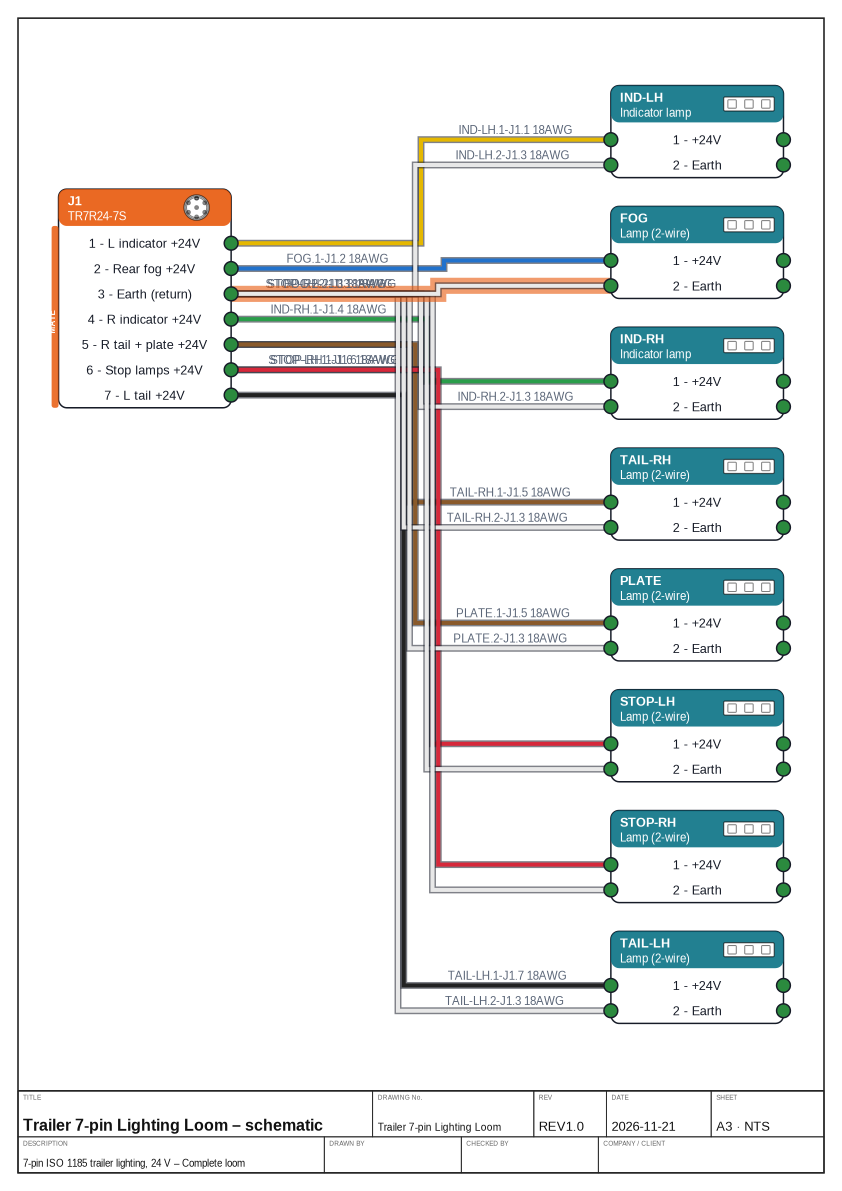
If you want a small, complete example before you tackle a whole tourer, open the Trailer 7-pin Lighting Loom training project. It is a 24 V, 7-pin ISO 1185 trailer lighting loom: schematic, loom diagram with run lengths, a pin-out / build sheet and a run schedule. The start-to-finish video walks through the same project. Trailer wiring diagrams are one of the most searched 12 V topics, and this is a real loom, not a poster.
Choose wire size from the current, the length and the conditions, and protect every high-current feed. LoomKit records the sizes you choose and gives you lengths from the 3D route. It is not a wiring-code calculator and it is not a substitute for a qualified auto electrician — especially on charging systems, inverters and anything that leaves the 12 V side.
Try it, then take it off-grid
Install LoomKit on Windows or Mac and design with up to 4 connectors, no time limit and no code. A full licence is $250 AUD + GST a year, one computer, and it works offline — useful when you are actually away in the van. The Android viewer is for checking a project on the go; designing stays on the desktop.
Related guides
Design the loom before you cut a wire
Install LoomKit on Windows or Mac and design with up to 4 connectors, no time limit and no code needed. A full licence is $250 AUD + GST a year, one computer, and it works offline.